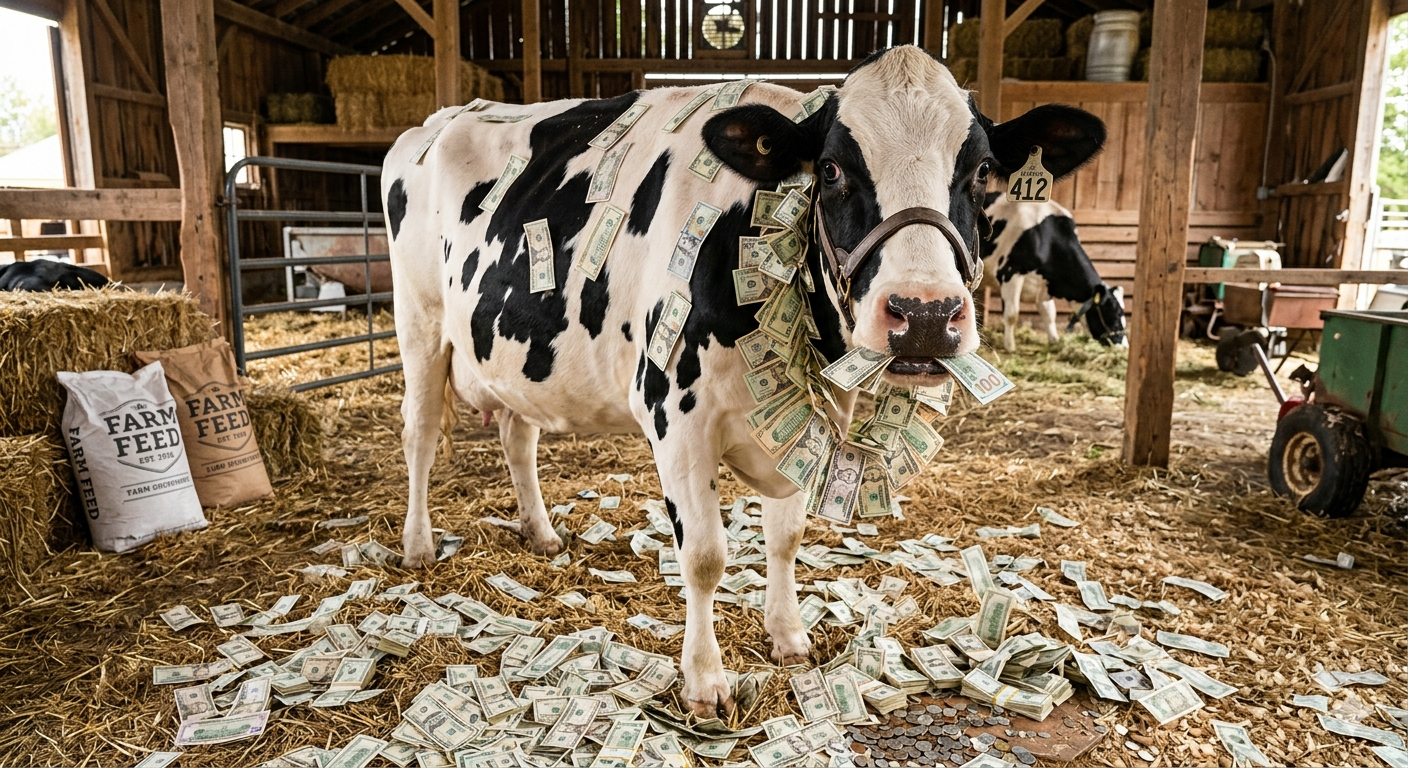
This past Monday I stood by the ring at the Mid-South Regional Livestock Center in Unionville, watching weaned calves walk through. According to the USDA market report, Medium & Large 1 steer calves averaging 624 pounds brought $430 to $455 per hundredweight ($4.30 to $4.55 per pound live), with a weighted average of $445.95/cwt. Do the math on a 600 pound weaned steer and you are looking at roughly $2,580 to $2,730 — around $2,676 on average — just to get one home.
That number always surprises people. "You mean a baby cow costs that much?" Yes. And that's where the expenses start, not where they end. Here's what it actually takes to raise a beef animal from a weaned calf to a finished steer ready for the processor — roughly 14 to 18 months of our time, feed, and attention.
The calf is the starting line
At Unionville on Monday, April 20, 2026, Medium & Large 1 steer calves in the 600 pound range averaged $4.46 per pound live weight. A 600 pound calf at that price runs about $2,676. That is your starting investment before a single blade of grass, a bale of hay, or a gallon of water. And prices actually softened a bit this week — feeder steers were $5 to $15 per hundredweight LOWER than the week before.
Cattle prices have been climbing for two years. The national beef cow herd is the smallest it has been since the 1950s, and Tennessee feeder prices reflect that. You can check the current numbers yourself at the USDA's Livestock Market News reports.
Hay — the single biggest ongoing cost
A growing steer eats roughly 25 to 30 pounds of forage a day. Most of the year our cattle are on pasture and eat for free — well, free-ish. Pasture doesn't grow itself, and I'll get to that in a minute. But in Middle Tennessee, winter grazing runs out by late November and doesn't really come back until April. That's five months, sometimes six, of feeding hay.
One 1,000 pound round bale of grass hay lasts a single animal about three to four weeks in winter. In Middle TN this year, good square-baled orchard grass is running $7 to $9 a square bale and round bales are $60 to $90 each. For one animal's one winter on the farm, that is 8 to 10 round bales — call it $600 to $800 in hay alone.
A place to graze (and fix the fence they just broke)
One beef animal needs 1.5 to 2 acres of good Tennessee pasture to graze without overworking the land. Pasture is not free grass. We fertilize and overseed every couple of years, bush-hog weeds to keep clover and fescue dominant, and spend more time than I would like fixing fence. We run high-tensile electric with wood corner posts — the initial install is thousands of dollars per mile, and the annual upkeep on fence, charger batteries, and gates is a few hundred at a minimum.
The University of Tennessee publishes good county-level budgets for small beef operations if you want to dig deeper at the UT Extension site.
Water — more than just a hose
A 1,000 pound steer drinks 10 to 20 gallons of water a day. In summer, more. That water comes from our well, which means we are paying the electric to pump it. We run a stock tank with a float valve, and in winter we run a tank heater so it doesn't freeze — another electric bill item. Between well power, a heater, and the occasional replacement float or line repair, water runs $75 to $150 a year per animal. Not huge, but real.
Minerals, vet, and the medicine we almost never need
Beef cattle need free-choice minerals year-round — a tub and loose mineral in a covered feeder, about $100 to $150 a year per animal. On top of that, routine working (worming, fly control, maybe a booster) runs another $50 to $100. We are BQA Certified, so if an animal ever does need antibiotics, we wait a full four weeks before processing — double the required withdrawal period — which means we absorb any treatment cost twice if it happens near market time.
Equipment, fuel, and the thing nobody prices in: time
Every farm has equipment behind it. A tractor to move hay, a truck and trailer to haul animals, a stock chute for handling, a sprayer for pasture, a post pounder for when the fence goes down. We don't depreciate it all for a single animal, but spread across the herd it adds a couple hundred dollars a year per head, easy. And I won't even try to price our hours — feeding twice a day in winter, walking fence weekly, hauling water when the freeze hits harder than expected.
Processing — the last bill
Once the animal is ready, she goes to a USDA-inspected processor for slaughter, cut-and-wrap, and dry-aging 14 to 21 days. That bill runs $500 to $800 depending on animal size and how you want the cuts done.
Adding it up
For one animal, from weaned calf to finished beef in your freezer, our real out-of-pocket is roughly:
- Weaned calf purchase (600 lb steer at Unionville): ~$2,600 – $2,700
- Hay (one winter): $600 to $800
- Pasture upkeep (allocated): $150 to $300
- Water (electric, heater): $75 to $150
- Minerals and routine vet: $150 to $250
- Equipment and fuel (allocated): $150 to $300
- USDA processing: $500 to $800
That is roughly $4,200 to $5,300 out of pocket per animal — before a single hour of labor. And that assumes nothing goes wrong: no sick calves, no fence down at 11 PM, no replacement tractor parts, no drought that doubles the hay bill.
What this means if you buy a share from us
When you reserve a quarter, half, or whole share, you are not just paying for meat. You are paying for the 18 months of work, feed, fuel, and risk that got that meat to your freezer. Our pricing sits in the same ballpark as grocery grass-fed, sometimes under, and you get traceability we can prove: one animal, one farm, photographed and named over at Meet Our Cows. You can come meet her before she is processed.
That is the real math behind a local cow. Thanks for reading — and for supporting a farm that still does it one animal at a time.
— Jess
The Disney Farm